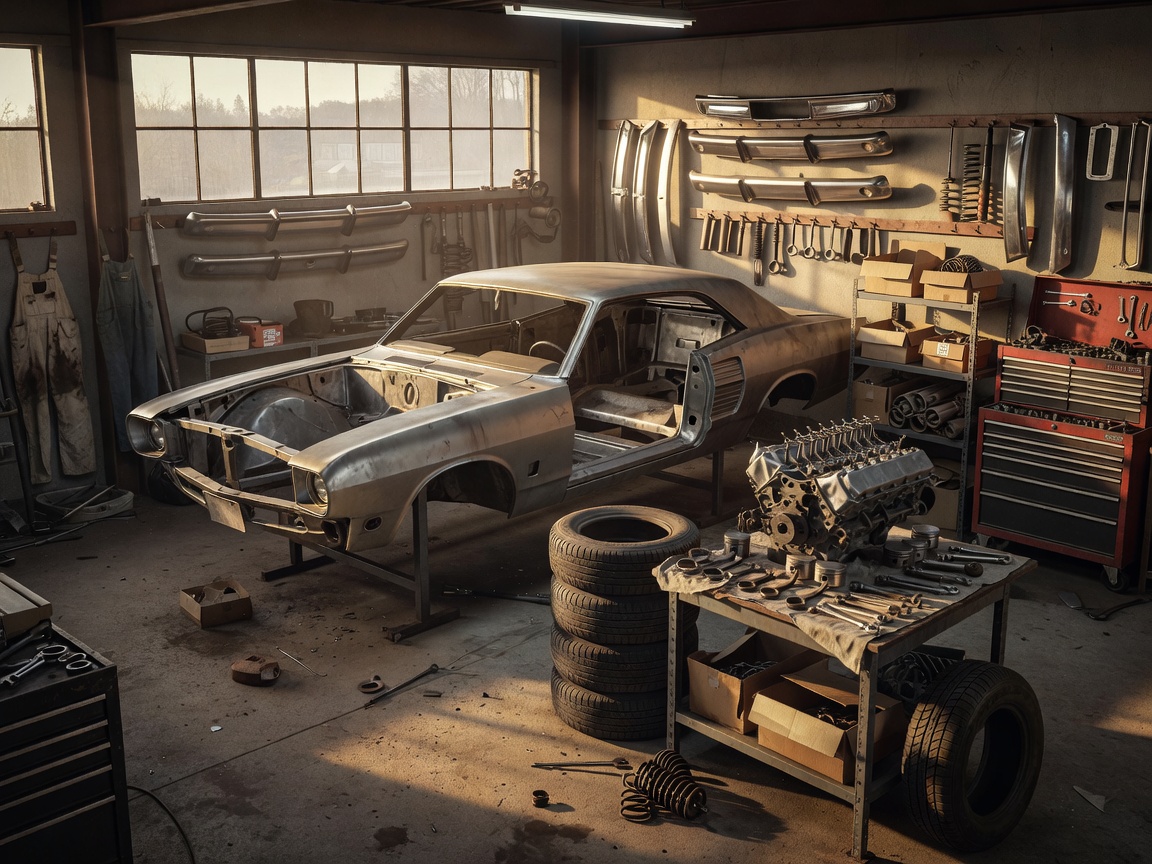
Preserve evidence before changing it
A historic vehicle carries more than its designed function. Materials, repairs, finishes and use marks can document its working life. Before work begins, a careful record can include photographs, measurements, written observations and available ownership or service documents. The purpose is not to make every intervention elaborate. It is to retain a traceable account of what was present and what changed.
Historical research can inform the work. Period photographs, parts catalogues, technical publications, registration records and correspondence may help establish a likely configuration. Sources should be evaluated for date, origin and relevance. A reference to one example does not prove that every vehicle of the same model had identical equipment. Where evidence is incomplete, the record should say so.
Conservation and restoration decisions depend on the object, its condition, intended use and significance. This guide describes terminology and questions for interpretation. It is not a mechanical repair manual. Safety-critical assessment and work belong with qualified professionals using appropriate information and procedures.
Three approaches, three balances
Conservation focuses on stabilizing an object and retaining existing material. Intervention is generally limited to what is needed for care, legibility or protection. Its advantage is the retention of physical evidence. Its limitation is that visible wear, incomplete components or non-running condition may remain. Conservation does not mean leaving an object at risk or refusing all maintenance.
Sympathetic restoration aims to improve condition or function while respecting a vehicle’s character and documented history. It may retain sound original parts, use compatible materials and avoid unnecessary alteration. The term is not a guarantee of quality or authenticity. A project should explain what “sympathetic” means in its specific context and document its choices.
Complete restoration typically involves extensive work across multiple systems or surfaces to reach a defined appearance or operating state. It can make a vehicle easier to understand, display or use. It can also remove substantial original material, introduce replacement components and obscure earlier repairs if records are weak. The degree of intervention and its evidence should be stated clearly.
Where intervention occurs
Bodywork and structure: repairs can affect shape, joins, material and evidence of previous work. Photographic records and descriptions help explain what was retained, repaired or replaced.
Paint and finish: a refinish may clarify presentation, but it can cover earlier layers and use marks. Analysis and project records can help distinguish a known finish from a visually plausible choice.
Interiors and trim: fabrics, fittings and surfaces may be repaired, reproduced or replaced. Wear patterns and surviving materials can offer evidence of use and specification.
Mechanical components: serviceable operation may require maintenance or replacement. Documenting component identity and work history helps keep later caretakers informed. This site does not prescribe technical procedures.
Replacement parts and authenticity
Replacement components can be necessary when material is missing, unsafe or beyond practical repair. The source, fit and degree of alteration affect how a replacement relates to the historic object. Reproduction does not automatically make a vehicle inauthentic, just as retaining an old part does not prove an unchanged history. Context and documentation matter.
Labels such as “original,” “period-correct” or “matching” should be specific. What component is being described? What record supports the claim? Does the term refer to a factory configuration, a period replacement, a surviving part or a later restoration choice? Precise language avoids turning a complex record into a binary badge.
Workshop practice and project records
A useful project file links condition assessment, research, decisions and work completed. It may include dated photographs, invoices, material notes, parts references, correspondence and explanations of deviations from the original plan. Records should identify uncertainty rather than fill gaps with assumption. They also help explain why a technically possible intervention was not selected.
For museums and collections, accessible documentation supports future interpretation. Visitors can understand the vehicle’s current state and the choices that shaped it. For owners, organized records can guide later care. In both cases, the record should remain with the object or be clearly associated with it when custody changes.
Good for
Visitors comparing vehicle condition, restoration exhibits, workshop displays and collection records. It provides vocabulary for asking how a vehicle was treated without making an unsupported authenticity judgment.
What to know
- Visible finish alone cannot establish originality.
- Restoration scope and evidence vary from project to project.
- Do not use general editorial guidance as a substitute for qualified technical or safety advice.
Related reading
For collection interpretation, read Classic Car Collections. For museum context, see Scandinavian Car Museums. Review the exhibition guide for ways restoration histories can be presented to visitors.
NEXT ACTION / RECORD